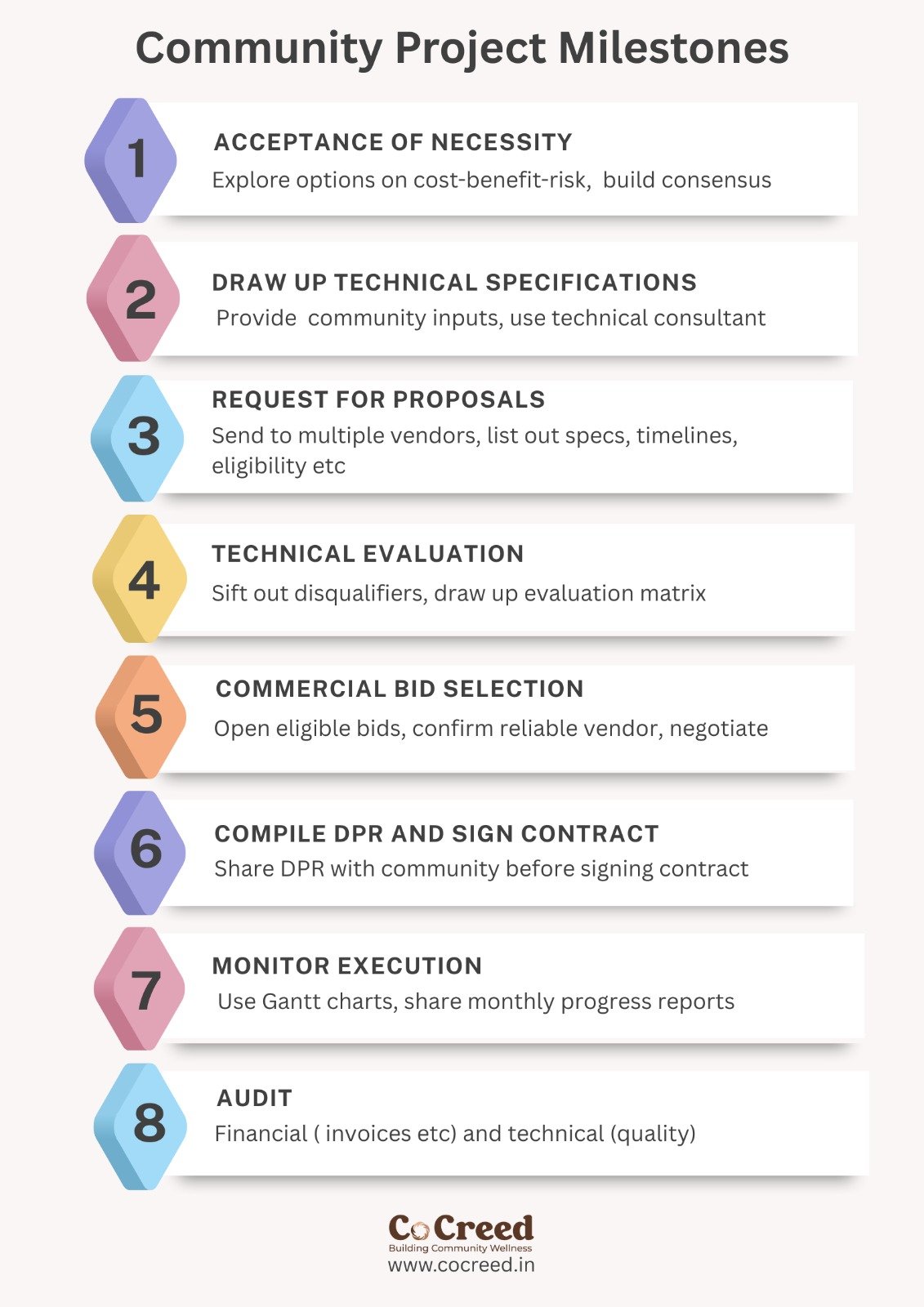
Evaluation of Technical Bids. Once responses are received, a technical committee which could comprise of some volunteer members and a qualified consultant, evaluates them. After disqualifying those which do not meet the specifications listed in the RFP, an evaluation matrix can be drawn up. A document stating the reasons for disqualification of a vendor, if any, and providing an interpretation of the evaluation matrix can then be shared with the community. It is possible that at this stage, additional features or costs or benefits of different products may come to light. If these are considered important and desirable, it may be worthwile to halt and repeat stages 2 and 3 with the amended specifications.
Stage 5
Opening of the commercial bids and selection of the optimal bid. Only those bids whose technical bids have cleared the earlier stage are considered. These are opened in a public meeting or with video recording. It is not necessary that the lowest bidder (called L1) is the best, since some vendors could lack the requisite expertise or attempt to grossly underbid. To avoid this situation, RFPs can include clauses for reasonableness of pricing and possible disqualification of a vendor who is unable to justify his capabilities with sufficient information.
In case the scope needs to be refined ( some vendors may ask for additional inputs to fine tune their offers) or a vendor wishes to rework the payment terms or some clauses on warranty need to be added, a contract negotiation can be held with the selected vendor. This must be done by an empowered committee, accompanied by a law aware person. Needless to say, the proceedings of the opening of bids, selection and negotiation should be recorded in writing.
Stage 6
Compilation of a Detailed Project Report (DPR). This is a compilation of all the documents of the stages with a summary providing a single source of truth and allows all members of the community to see how decisions were made, not just what was decided.
After the DPR is shared with all members on the community website, some valid concerns or insights—especially those with domain knowledge may arise. If these are major or critical, the community has a chance to step back and take a re-look. This feedback loop can also help refine contract terms, flag overlooked risks, or suggest better service-level clauses. A well-documented DPR reduces the risk of post-contract disputes by showing that due diligence was done. Lastly, and most importantly, it protects volunteer committee members from allegations at a later date, of procedural lapses or mismanagement.
Once community consent is apparent, the contract can be signed between the community representatives and the vendor, along with those of the consultant and two independent witnesses.
Stage 7
Monitoring execution. Execution of a project can be tracked through a project dashboard with tools such as Gantt charts, Weekly progress reports, site inspection logs etc. A monitoring team of volunteers and a consultant can prepare monthly reports which can be updated on the community notice board. Many contracts include a Liquidated Damages (LD) clause which imposes a penalty on the vendor for delays in supply or completion of the contracted work. But delays can occur due to reasons attributable to the vendor or the community. For example, the areas for laying out the pipelines may not be cleared by the community in time. The monitoring team therefore needs to record the reasons with fairness and share them with the community as a justification of the final penalties which may be fairly imposed.
Independent Audit. After the project has been completed, it helps to conduct a financial audit ( to check invoices and payments) as well as a technical audit ( quality of installation). This should be done by a third party auditor or a qualified member who is not involved in the execution.
Many may question the need for an audit, with views that it is too late to correct anything and may only bring up unpleasantness against those who were involved in execution and thereby lower community spirit. However, audits can reveal many areas of systemic weakness and can be used as stepping stones for improvement. The lessons learnt can be recorded and publicly shared for use by future project teams.
The figure below summarises the steps and important actions needed: